top of page

Many times, startups fail or are forced to pivot – not because they build products poorly, but because they built something no one wants. Before you build, prototype, and pitch, consider taking a few minutes answering the following deceptively simple questions:
Product-Market Fit
Before You Build: 2+1 Questions Every Founder Should Answer
Often startups fail or are forced to pivot not because they build products poorly, but because they built something that doesn't address real needs. Before you build, prototype, and pitch, consider taking a few minutes answering the following deceptively simple questions:
Question 1
Who is your target audience? Who are you building for?
The first common pitfall is the fear of missing customer segments. “But how about this other group, can’t we target them too, so our market is bigger?” is a question that we encounter a lot when talking to early-stage startups.
The second common pitfall is using a demographic blob as the target audience group. The most common ones, as many of you can probably guess, are “Gen Z” and “busy professional with a household income of 100k+”. While demographic information can be helpful in some scenarios, try to think about your target audience based on their motivations and needs.
Identifying target segments based on their primary needs can be a more effective way. See below an example for a furniture startup.

If I am trying to figure out who the target audience for my new furniture venture, I would start by identifying the distinctive primary needs of people buying furnitures, and use the primary needs to bucket customers.
Question 2
What user problems are you solving?
It is extremely hard to convince your target customers that they have a problem your product can solve, if in fact, they don’t.
A common pitfall here is caused by confirmation bias and compliance bias. While we, as the owner of the idea, tend to ask questions and guide conversations towards directions that prove our assumptions, the participants in our user interviews and other research tend to agree with us. A very simple example is that if you ask “Do you think you have XYZ problem?” Most will agree to some degree, even when they absolutely don’t have this problem.
Therefore, we want to share some tactics and tools that are helpful in identifying user problems with as little bias as possible:
Ask open-ended questions
Instead of asking “if you have XYZ problem” in early user interviews, ask the participants to describe their experience and ask follow up questions. In general, people are much better at describing past experiences rather than imagining future hypothetical situations.
Try Forums
Digging into forums, subreddits, and communities can be a good way to observe and discover user problems in a natural and truthful setting.
Research existing workarounds and inferior solutions
A less direct way to discover and prove a user problem, is to see if the users are currently creating their own ways to work around the problem (e.g. worksheets, hacks, etc.) and if they are paying for less-than-ideal solutions.
Lastly, one small tip that always works: Don’t pitch, just listen. No matter how eagerly you want to talk about your idea, just listen. If the user describes the problem you are targeting voluntarily – you've found your answer.
Bonus Question
Are the problems big enough for the users to be willing to pay and/or change their behaviors?
Now that you have identified the target audience and proved that the problems they face are real, there is one more question to be answered – Are they willing to pay for it or change behaviors for it? On top of quantitative measures to size the opportunity (TAM, SAM, SOM and so on, you likely have already done these), we can roughly gauge this question qualitatively too.
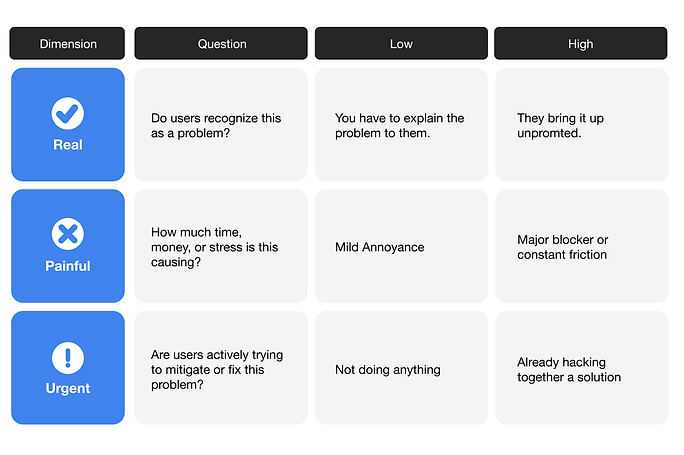
We often see successful entrepreneurs view this question as a threefold analysis – real, painful, urgent.
Real – We already covered this above.
Painful - How much time, money, or stress is this causing for our target audience?
Urgent - Are our target audience actively trying to fix this now?
TL;DR: Before You Build, Make Sure You’re Solving the Right Problem
As tempting as it is to dive into wireframes, pitch decks, or code, spend some time thinking through these three questions to give yourself and your team more clarity.
1. Who is your target audience? Who are you building for?
2. What user problems are you solving?
3. Are the user problems big enough for the users to be willing to pay or change their behavior?
At M Group Creative, we help startups get clarity fast with user-centered insights, testing, and product strategy. If you’re working through these questions, we’d love to brainstorm with you. Simply DM us on LinkedIn or via email to schedule a free consultation or a free user problem assessment.
Author: Rachel Qian
bottom of page